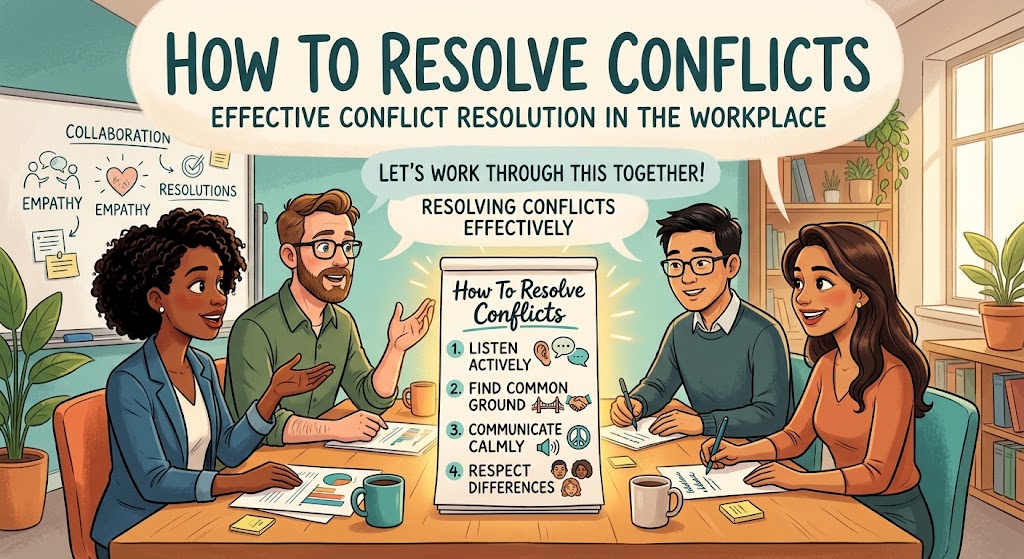
| How To Resolve Conflicts | ||
| Instructor: TJ Guttormsen |  | |
| Released: 6/1/2021 | Course Details 52m Advanced | |
| Skills Covered Conflict Resolution | Course Link | |
| Professional Certifications and Continuing Education Units (CEUs) N/A | ||
Fundamental Conflict Resolution Tools
The three rules: Stick to the case, be respectful, don’t project
Stick to the case
Don’t bring back past arguments/conflicts. Focus only on the conflict at hand and leave the past, in the past. The only exception is a past conflict that has returned.
Avoid personal attacks
Be respectful of the other person. If you catch yourself attacking a person’s character, stop yourself and apologize, then focus the conversation on resolving the conflict.
Never tell the other person about themselves
Never assume other’s intentions. All you should talk about is your personal experience on the conflict. You can paraphrase what they have said but you cannot assume you know what they were thinking when they completed an action.
Beware underlying causes: Is the conflict really what you think it is?
Always consider whether or not there is more to a conflict than what there seems to be on the surface.
Create an intent to collaborate: “Us against the problem”
- State your intention to collaborate
- “My goal here is for us to figure a solution to this together.”
- Refocus when necessary
- “I’m sorry, I’m noticing that I am getting carried away and forgetting my intention of collaborating on a solution.”
- Give reassurances
- Make an extra effort to listen to them when they respond to what you’ve said and make sure that you fully understand their experience.
What to do when you disagree on what the conflict is
If we can’t agree on what happened, how it happened, or why it happened, because we have different experiences of the situation, we can apply the conflict resolution techniques from this course to each of those experiences, and come up with a solution to each issue.
How to handle repeating conflicts
- Explore if underlying factors are causing the conflicts
- Look at our behaviors and our solutions
- Take a close look at how each of you understand and interpret the agreements that were made.
- Create a new and exaggerated agreement
- Start over – establish a new agreement with new actions
- Make a structural change in the relationship.
“I” statements and absolutes: The dos and don’ts
Use I-statements when we describe things:
- “I felt like…”
- “I thought that…”
- “I experienced…”
Stay away from works like “always” or “never”. These are absolutes and others immediately get defensive and start thinking of one example to disarm your comment.
The Conflict Resolution Process
Personal preparation: Map the conflict and check in with yourself
The first thing we want to do when we are the one feeling upset with someone else is check in on our own overall wellbeing. Ask yourself questions like:
- “How am I feeling right now?”
- “How have I been feeling, generally speaking, in the time the conflict has existed?”
- When did the conflict start?
- Was it a one-time thing, or is it an ongoing issue?
- What is your experience of the problem?
Put yourself in the other person’s shoes
Think about what the other person is experiencing.
- How do I think they are experiencing this situation?
- If they weren’t trying to cause a problem, what might have been the reason they did what they did?
Manage your expectations
If we go into conflict resolution conversation without having realistic expectations, we’ll almost always be disappointed.
- What am I hoping to achieve by addressing this conflict?
- What is my ideal solution?
- What is a good solution?
- What is my least acceptable solution?
Schedule the conversation
It’s important that you don’t surprise someone with a conflict resolution conversation. They’ll often become defensive, which makes it hard to have a collaborative conversation. They might also not have given the situation enough thoughts to be able to clearly explain their experience to you.
Set ground rules
“Before we begin, I have some thoughts on how I’d like to do this conversation. Can I share them with you?”
You’ll also want to add that it’s important to you that you’ll both focus on understanding the problem as the other person sees it, rather than arguing about whose version is the most correct.
Remember: You’re not just agreeing on how to have the conversation, you’re also in the process of building trust.
Clarify the conflict to get on the same page
Make sure you take a moment to be specific about what the problem is, and ask the other person to do so too.
Share your experiences using “I” statements
It’s very likely that the person having the conflict will not be using “I” statement. They will likely make claims about your intentions and thoughts to exaggerate with absolutes and so on. Your job isn’t to correct them while they speak, your job is to translate what they’re saying in your own mind.
Solutions and compromise
A good way to start the solution finding process is for each person to talk about what they would need to feel okay with the situation, or be confident that the problem won’t happen again.
The informal contract
Once the two of you have agreed on a solution, write it down and make it easily available to everyone involved. By writing it down, it becomes an informal contract. It also clarifies what the solution is and makes it easy for both of you to refer back to it in the future, if you need to.
Getting help from a third party
In some situations though, for a variety of reasons, we’ll realize that we won’t be able to solve the conflict on our own. When that happens, we can bring in a third party to help us out.
The third party must be:
- Objective
- Impartial
- Assertive
It will be a huge advantage for both of you, if this third party has at least a basic understanding of conflict mediation.
 | Remember! To experience the full benefit of this guide, I highly recommend you watch the full training session. |