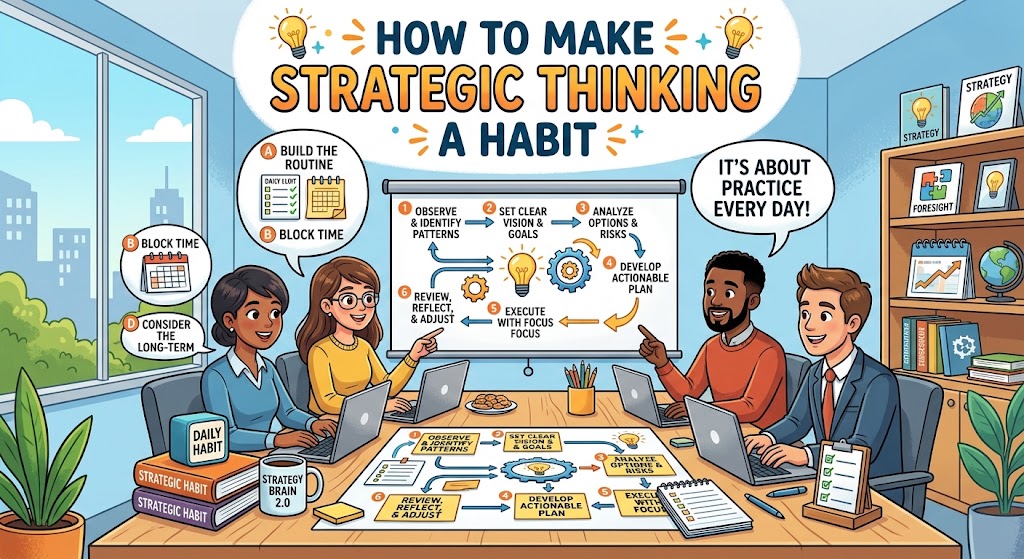
| How to Make Strategic Thinking a Habit | ||
| Instructor: Dorie Clark |  | |
| Released: 7/11/2023 | Course Details 37m General | |
| Skills Covered Strategic Thinking | Course Link | |
| Professional Certifications and Continuing Education Units (CEUs) Project Management Institute (PMI) – PDUs – 0.5 | ||
Setting Yourself Up for Strategic Thinking
What is strategic thinking?
What can I do today that’ll make tomorrow easier and better?
Strategic thinking is about asking how we can create the future we want.
Strategic Planning
Take a strategic vision and then work backward from it to figure out how to accomplish it.
Scenario Planning
Consider different possible futures and develop plans to address them.
SWOT Analysis
Analysis of strengths, weaknesses, opportunities, and threats
Making time for strategic thinking
Make Time for Strategic Thinking
- Put time on your calendar. Protect your calendar.
- Multitask. Muse about a problem.
- Practice writing every day.
- Leverage wasted time.
Travel time and wait time are particular good opportunities to think
Finding the right place for strategic thinking
- Change your location. That forces you to adapt and change quickly.
- Work from somewhere else. This may help you shift your perspective.
- Go outside. Fresh air and sunlight could brighten your mood from the office space.
Strategic thinking techniques
- What’s the total commitment?
- How much effort is this going to take.
- Scoping out projects properly by asking clarifying questions.
- What’s the physical or emotional cost?
- What’s the opportunity cost?
- The cost of doing something means you won’t be doing something else.
- How will I feel about this in a year?
Make small changes to spark strategic thoughts
- Make audio recordings of conversations.
- Ask permissions beforehand – record meetings
- Use pen and paper instead of a computer.
- Opens up different ways of perceiving things.
- Draw to use a different part of your brain.
- Sketch out the idea and see if they kit together – Venn diagram, pyramid, flow chart
Strategic Thinking Tactics
Forget to-do lists
To-Focus List
Develop a “to-focus” list instead of a “to-do” list focusing on bigger picture.
- 90 day list – new employee onboarded and operating smoothly.
- One Year list – have been promoted
- Five Year List – manage a large team
To-Be List
Invitation of who you want to be in the world.
How to analyze your decisions
- Write down your assumptions.
- Examples
- Develop new product in 6 months
- Bring to market in a year
- Sell 50,000 units in a year
- Examples
- Practice scenario thinking.
- Scenario Thinking: Bringing forth ideas you might overlook or possibilities that might seem extreme or improbable, which may prove useful.
- Option A – Everything goes according to plan.
- Option B – Product development is delayed by 3 months.
- Option C – Two key team members quit and product development is delayed by one year.
- What would you do?
- Use premortem and postmortem analysis.
- Premortem: Identifying areas of weakness before a project is launched.
- “If this initiative were going to fail, what would be the likely cause or causes be?”
How to constantly improve your strategy
- Create an inspiration file.
- Give yourself an assignment.
Look at the root cause of problems
Identify the root cause of the problem and solve that.
Identify the Root Cause
- Confirm the facts
- Have clear goals.
- Use the five whys process.
Getting to the root cause helps you solve other problems downstream.
The Most Important Strategic Questions to Ask Yourself
How can this be easier?
Streamline Processes
- List every step in the process.
- Establish roles
- Take minutes
- Distribute minutes
- Approve minutes
- Create deck
- Evaluate deck
- Determine which steps are essential.
- Conduct a test
What can you cut out?
- Ask Questions
- What is most critical?
- What is most time sensitive?
- Eisenhower matrix
- Delegate
- What can you hand over to someone else?
- What can you systematize?
- Simplify Processes
- Where can you make cuts and improve performance or results?
The art of strategy is deciding what not to do.
What is unlikely to change?
- Be aware of the landscape around you.
- Keep up on industry trends
- Find out what’s important to your boss
- Know your company’s priorities
- Read newspapers and industry publications
- Know the basics of your industry and of business.
- Understand what might change.
Where can you get more leverage?
- Where else can we deploy an existing asset?
- How can we do two things at the same time?
- Look for complimentary things to do at the same time.
 | Remember! To experience the full benefit of this guide, I highly recommend you watch the full training session. |