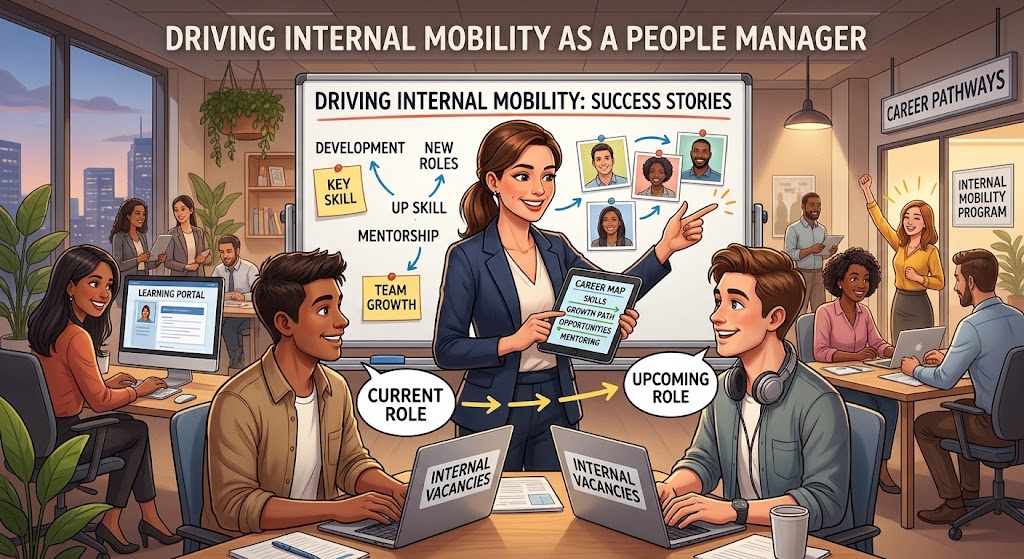
| Driving Internal Mobility as a People Manager | ||
| Instructor: Lindsey Pollak |  | |
| Released: 8/9/2023 | Course Details 53m Intermediate | |
| Skills Covered Internal Mobility Team Management | Course Link | |
| Professional Certifications and Continuing Education Units (CEUs) Project Management Institute (PMI) – PDUs – 0.75 | ||
Understand Internal Mobility in Your Organization
Simple questions to uncover current employee career paths
Your first goal as an internal mobility driver is to scan through data.
Uncover the state of internal mobility in your organization
- Does internal mobility happen in your organization?
- A promotion on the same team
- A lateral move to another team
- A career transition within the organization
- How are career paths discussed?
- Are available jobs promoted internally?
Overcome organizational roadblocks to mobility
An organizational roadblock is anything that might prevent your success.
Hold a pre-brief.
A pre-brief anticipates what might go wrong and works backward to prevent the problem from happening.
- Brainstorm every potential roadblock to internal mobility. Try to find 3-5 potential barriers.
- Next to each roadblock, list one step to mitigate or avoid the possible challenge.
Tips for handling internal mobility resistance
Handling Internal Mobility Resistance
- Casually check in with five people you work with frequently.
- Uncover people’s emotions around internal mobility.
- Hear and accept their feelings.
Co-create Employee Career Journeys
Become a champion of internal mobility
Employees who move to new positions internally are 3.5 times more likely to be engaged and stay in an organization. – LinkedIN Learning report.
Take at least one action each week.
- Ask and collect stories of those who made career moves.
- Sign up to receiving internal job listing across your organization.
- Start a job shadowing program on your team.
Map skills to the jobs on your team
Skills-Based Hiring
Identifying the specific skills a job requires for success and screening candidates based on whether they possess those skills.
Widen talent pool parameters. Creates inclusion for non-traditional backgrounds. Use skill-based language in defining job qualifications that you oversee.
Identify the most important skills required to do the jobs on your team. Think about the skills demonstrated by your employee or team in a big success.
Skill Gaps
Areas where an employee’s skill set does not match the skills most important to perform the job.
Integrate skills-based language into the flow of work
Integrate skills-based language into your flow of work and communication.
- Mention which top skill or skills are required when giving an assignment or direction.
- Use skills-based language when you give an employee feedback.
- During 1-on-1 and performance reviews, encourage employees to identify their top skills and skills they want to build or improve.
Facilitate employee career conversations
Career Conversation Script
- Invite the employee in a positive way.
- Provide an agenda or discussion questions early.
- Introduce the possibility of internal mobility in relation to their goals.
- Ask “What can I do as your manager to help you advance your career?”
- Agree on next steps.
Ignite Employee Development Opportunities
Make space for learning and development
Make space for learning and development for all your employees.
Schedule one action each month to promote learning and development to employees.
Suggestions:
- Host a monthly lunch and learn.
- Send a monthly email highlighting that month’s training programs or online courses.
- Host an event, like a hack day, for everyone to work on a project together.
Facilitate internal networking
“Keep building your relationships. Everything you want to do will require the help and support of other people.”
Find one internal event or activity every month to attend. Invite your employees to join you.
Encourage your employee to build their network. Introduce them to people they want to meet or those who might be a valuable connection.
The value of employee resource groups
Employee Resource Groups (ERGs)
Voluntary groups led by employees who create a community in their workplace based on shared characteristics or life experiences.
- Visbility
- Networking
- Training and development
Join at least one ERG or an additional group if you’re already involved.
Build an Ongoing Culture of Internal Mobility
Internal mobility as a driver of well-being
10,000 global knowledge workers found that approximately 70% of people experienced burnout in the last year. – Asana study
Chapter 1
Mention well-being in your discussions with resistant leaders.
Chapter 2
Talk to employees about improving skills related to stress management.
Chapter 3
Promote or create well-being resources.
Integrate internal mobility into hiring and onboarding practices
Revise your hiring guidelines and processes.
Integrate Internal Mobility into the Job Description
- Identify the tasks and prominently mention the required skills
- Decide if the position requires a specific educational degree
- Skilled through alternative routes (STARs)
- Indicate internal candidates including remote positions, are encouraged to apply
Integrate Internal Mobility into the Job Interview
- Prepare your interviewers
- Communicate to internal and external candidates that your organization supports employee development and internal mobility
- Ask questions that invite candidates to use skill-based language
Integrate Internal Mobility into Onboarding
- Provide a thorough training on all organization divisions
- Encourage networking from day one
- Talk about future movement
Demonstrate ongoing commitment
Set up a search alert for the “internal mobility” or “succession planning” and engage with and learn from this content.
Offer yourself to ERGs, industry associations, or other professional groups as a speaker or panelist on internal mobility.
Ask to add internal mobility, succession planning, and career planning topics to the agenda for large company events.
Keep in contact with your organization’s recruiters and HR department.
 | Remember! To experience the full benefit of this guide, I highly recommend you watch the full training session. |