| Conflict Resolution Foundations | ||
| Instructor: Lisa Gates |  | |
| Released: 10/1/2018 | Course Details 51m Beginner | |
| Skills Covered Conflict Resolution | Course Link | |
| Professional Certifications and Continuing Education Units (CEUs) National Association of State Boards of Accountancy (NASBA): CPE – 1.4 | ||
Anatomy of Conflict
Playing the name, blame and claim game
When conflict erupts:
- You are deprived of something you need or want
- Someone else is causing the deprivation
- The deprivation violates a value, social norm, or rule
- What value, social norm, or rule are they breaking? This is the “Claim” part of the cycle.
- What are you being deprived of? This is the “Name” part of the cycle.
- Who is doing the depriving? This is the “Blame” part of the cycle.
Understanding conflict styles
Thomas-Killman Conflict Model
Illustrates how people typically behave when faced with an uncomfortable situation.
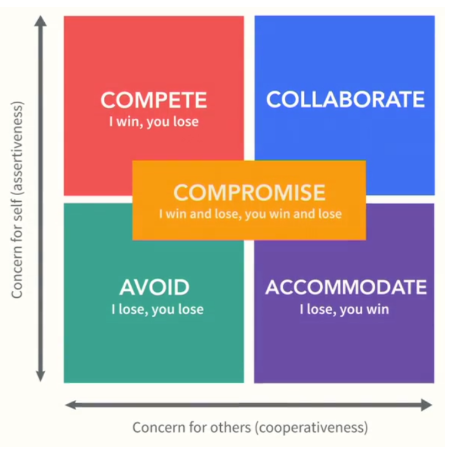
- Avoid – you don’t act for fear of rejection.
- Accommodate – you have the will to ask but when receiving pushback you fold.
- Compete – you ask and you double down in the face of pushback.
- Collaborate – you ask and are willing to brainstorm to come to a solution.
- Compromise – you ask but are both willing to concede a point or two.
Collaborate and Compromise can be switched in position to try to have both parties win.
Recognizing contentious tactics
Contentious Tactics
- Ingratiation – getting what we want through sweet talk or flattery. It may work once or twice but over time it will diminish your working relationship.
- Promises – getting what you want now by agreeing to do something later. This is a useful tactic if employed for mutual gain.
- Persuasive argumentation – using logic and reason to attempt to change someone’s behavior or position. It’s pretty useful but not always successful because it side steps participation and brainstorming.
- Shaming – express shock or disapproval at someone’s behavior.
- Threats – getting what we want out of someone by saying we would cause other persons harm if they don’t comply.
- Physical force – anything from pushing, hitting, and shoving to war and terrorism.
Unwinding cognitive bias
Cognitive Biases
- Hindsight – aka “I knew it all along” – view past events as being predictable.
- Fundamental attribution error – explain the personality of others as personality defects while minimizing the role of situational influences. Leap to conclusions ahead of getting the facts.
- Confirmation bias – confirms your preconceptions, seeking others that agree with your conception.
- Belief – not on merits but on the belief of the conclusion. Example; management pushing manufacturing to complete more volume believing more is better. Any proposal favoring quality over quality will be rejected.
How am I viewing the conflict? What filters and biases might be clouding my vision?
Resolution Road Map
Identifying issues and needs
Think of a Situation and Ask
- Is it rational?
- Is it substantive?
- Is it perceptual?
To investigate your needs and behaviors, ask:
- What do my actions and behaviors demonstrate about what I want?
- How would I behave if I was really committed to what I want?
Distinguishing fact from fiction

Fact from Fiction Exercise
- How are you behaving?
- What stories are justifying your behavior?
- What feelings do your stories generate?
- What might also be true?
- How can you take your part in the conflict?
Opening the conflict conversation
A Successful Opening
- State the facts as you see them.
- Tell your story and own it.
- Ask your conflict partner for their perspective.
Gaining alignment and brainstorming
Your partner is part of getting to the solution.
The Big Deal Question
What are we committed to? What goal are we trying to accomplish?
Getting to agreement
Be diligent about identifying next steps. Nail down the who, what and by when.
Deepening Conflict Resolution Skills
Increasing your conflict capacity
First, identify five behaviors you would like to change. Then determine, what was your trigger? How triggered or upset were you? Identify your capacity to deal with the feelings that come up around that trigger.
Your goal is to reduce the intensity if your trigger to closer align with your ability to deal with the conflict.
Asking diagnostic questions
Diagnostic Questions
- Begin with who, what, when, where, how and why
- Key to learning your conflict partner’s perspectives
When asking closed ended questions, you will most likely receive a yes or no answer. For a conflict avoider, you will always get a no.
No is part of the journey to yes.
Listening
Levels of Listening
- Level 1 – Be self-oriented
- Level 2 – Focus on what is said
- Level 3 – Focus on what is and what is not said
Listening Ability Tips
- Close the door, turn off ringers and distractions
- Get present
- Breathe and make eye contact
- Give cues that you’re listening
- Reflect what you hear
Labeling, mirroring, and silence
Tactical Listening Skills
Used purposely to discover information that will move the conversation forward
Labeling
Paraphrasing what you heard, typically starting with “it sounds like…”
Mirroring
Repeating the last few words or critical words. Most useful when confused or triggered.
Silence
Useful when we really have no idea what to say or when someone said something so out of bound that we need to take the temperature down.
Reframing
Framing
The way we describe or characterize a problem.
- Asking questions helps you understand your conflict partner’s interests and goals.
- Paraphrasing helps double-check your understanding.
- Mirroring signals to your conflict partner what they’ve said.
- Labeling helps you build tactical empathy by reframing the feeling or need of the other person.
 | Remember! To experience the full benefit of this guide, I highly recommend you watch the full training session. |